How to build a backlog recovery plan for a factory
"Send me a recovery plan by Friday." When a plant falls behind, management wants two answers: when will we be back on track, and what will it cost. This guide shows a four-step method that gives both, on a worked example for a whole plant.
The example plant
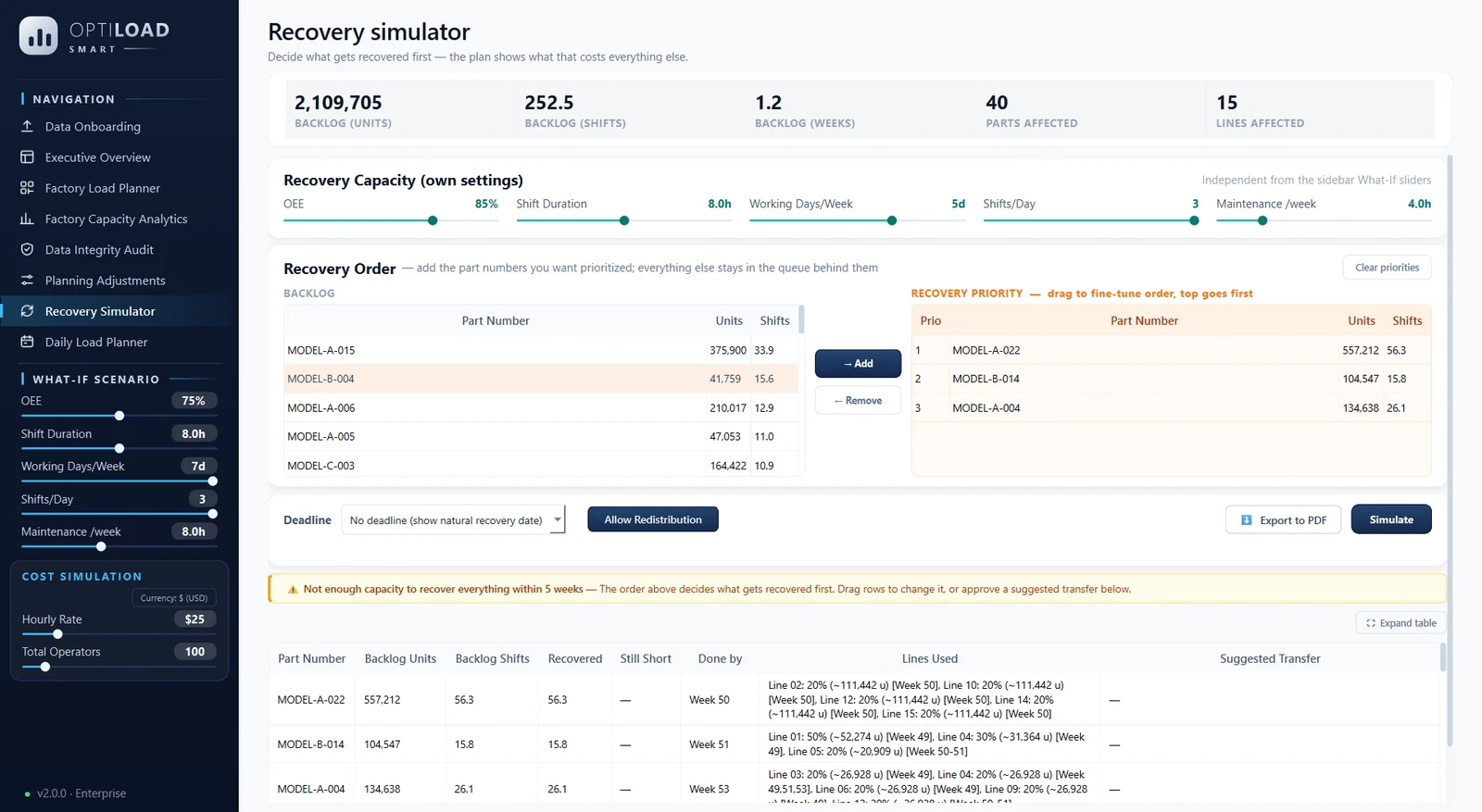
15 production lines, 3 shifts a day, 5 working days a week, 8-hour shifts. After a difficult quarter the plant is behind on 40 part numbers. All figures below are for the whole plant, all 15 lines together.
| Backlog | Whole plant |
|---|---|
| Late units | 2,109,705 |
| Line time needed to recover | 252.5 shifts |
| Part numbers affected | 40 |
| Lines involved | 15 |
Step 1: measure the backlog in shifts, not units
Units are what the customer ordered; shifts are what the plant has to spend. Convert every late part into line time with its own cycle time on its own line.
In the example, MODEL-B-004 is only 2% of the late units but 6% of the line time needed. Ranked by units it sits near the bottom of the list; ranked by shifts it is one of the real problems.
Step 2: rank recovery levers by the capacity they return
Normal capacity of the plant is 15 lines × 3 shifts × 5 days = 225 shifts per week. Each lever is expressed in the same unit, so they can be compared honestly.
| Lever | Extra shifts / week | Catch |
|---|---|---|
| Saturday + Sunday, 3 shifts | +90 | Highest premium pay, fatigue after 2–3 weeks |
| Saturday, 3 shifts | +45 | Needs agreement in time |
| OEE 75% → 85% on the late lines | +30 | Cheap in money, slow to prove |
| Move volume to lines with free capacity | varies | Only where the part is approved on that line |
| Extend a shift 8 h → 9 h on 5 lines | +9 | Overtime limits |
| Halve planned maintenance | +7.5 | Borrowing from next month |
With Saturdays only, 252.5 shifts take about 5.6 weeks to clear; with full weekends and OEE raised to 85%, about 2.1 weeks. Apply each lever only on the lines that carry the backlog: an extra Saturday on a line with no late parts returns nothing.
Step 3: decide the order, and show what it costs
Capacity is limited, so the order decides who waits. A practical rule: line-stop risk at the customer first, then contractual penalties, then the largest backlog in shifts, then due date. In the example three parts go first:
| Priority | Part | Backlog shifts | Back by |
|---|---|---|---|
| 1 | MODEL-A-022 | 56.3 | Week 50 |
| 2 | MODEL-B-014 | 15.8 | Week 51 |
| 3 | MODEL-A-004 | 26.1 | Week 53 |
Not everything fits in 5 weeks. The three priority parts are safe; the other 37 move behind them. Management needs to see that sentence before agreeing the plan, not three weeks later.
Step 4: turn the weekly plan into tomorrow's load
A recovery plan that lives in a weekly report never reaches the line. For every line on the recovery list, build the next day: which parts, how many, in what order, with changeovers and breaks counted and the finish time visible. If the day does not fit, you find out the evening before.
Checklist for your next recovery meeting
- Backlog listed per part in shifts, not only units
- Backlog compared with the capacity left after current demand
- Each lever priced in extra shifts per week, applied only to the late lines
- Recovery order written down and agreed with management
- Completion week per priority part, and the parts that move behind them
- Cost of the plan: overtime, weekend premium, idle capacity elsewhere
- Daily load built for every recovery line